
1416/20.80.11.3
Description
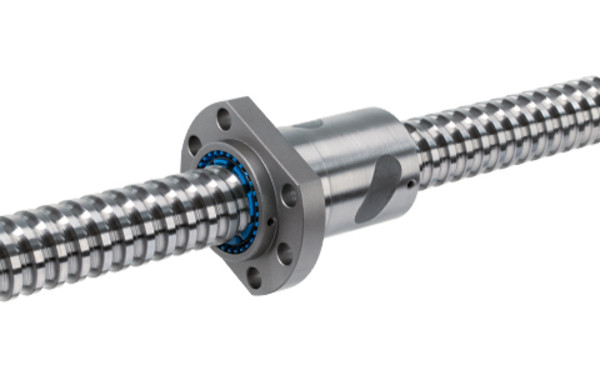
- Nut Series 1416 with internal ball return, Flange single nut with 4-point-contact with standard synthetic wipers on both ends
- Nut shape according to DIN for assembly by flange
- Single start ball thread, ground execution according to accuracy class P1 - P5
Technical Data and Dimensions
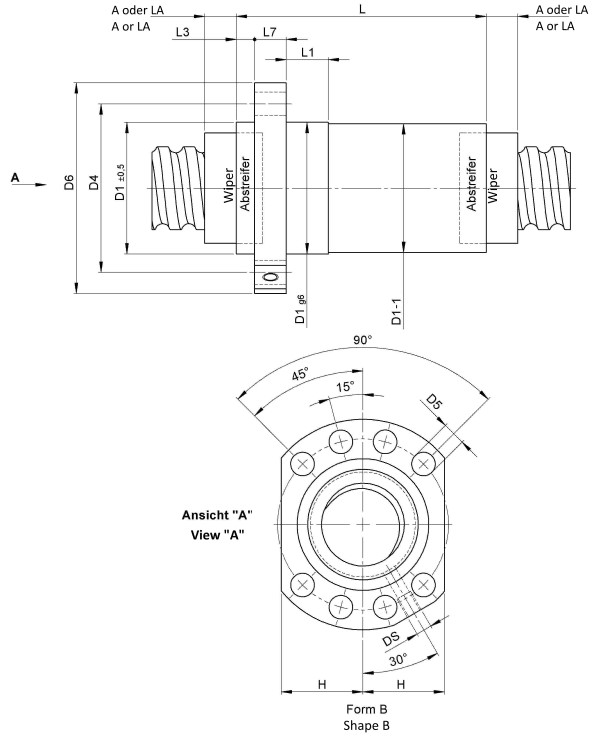
- Series
- 1416
- Nut length
- [mm]
- L
- 143
- Nominal diameter
- [mm]
- dN
- 80
- Wiper extension
- [mm]
- L3
- 7
- Lead
- [mm]
- P
- 20
- Flange thickness
- [mm]
- L7
- 25
- Ball circles
- i
- 1x3
- Dynamic load capacity
- [kN]
- Ca
- 134,20
- Ball diameter
- [mm]
- dW
- 11
- Static load capacity
- [kN]
- C0a
- 283,50
- DN-value
- 120000
- No. of starts
- 1
- Additional wiper extensions for combination wipers
- [mm]
- LA
- 10
- Stiffness
- [N/µm]
- Rnu,ar
- 900
- Pilot Length
- [mm]
- L1
- 25
- Pilot diameter
- [mm]
- D1
- 125
- Pilot diameter tolerance
- [mm]
- g6
- Bolt circle diameter
- [mm]
- D4
- 145
- Flange hole diameter
- D5
- 13,5
- Max. preload
- [kN]
- 10,736
- Flange diameter
- [mm]
- D6
- 165
Didn't find what you're looking for, need advice, or already have a solution in mind?
Make use of our technical expertise for product selection and system design:
When is a rotating nut the better choice compared to a rotating shaft?
Whenever high speeds need to be combined with long axis lengths, when the shaft should be rigidly clamped and pre-tensioned at both ends, or when liquid cooling of the shaft is needed. With a stationary shaft, critical speed plays only a minor role and, provided the nut runs sufficiently true, can be exceeded, allowing significantly higher traverse speeds than with a rotating shaft.
Can I get a rotating nut built to my own drawing?
Yes. In addition to our standard series, we manufacture rotating nuts to customer drawings and work with you to develop tailored solutions for your application.
Are rotating nuts preloaded?
The standard design uses 4-point contact with preload achieved through ball oversize. Special designs with 2-point contact are also available on request. Please contact us for applications with specific requirements.
How is a rotating nut lubricated?
Because the nut itself rotates, lubricant must be fed through a rotary union directly into the nut. The resulting centrifugal forces need to be factored into the lubrication design. Our application team is glad to help you find the right setup for your use case.
What role does the drive motor play with rotating nuts?
Direct drive of the nut requires a hollow-shaft motor, through which the stationary shaft is routed. Motor heat generation should be factored into the design, since it occurs in close proximity to the nut.


